
11 Months, 11 Child Safe Standards – Keeping Children Safe Together
At Antonine College, the safety and wellbeing of every child is our highest priority. Guided by our Catholic faith and our commitment to caring for the whole child, we continually work to ensure our school remains a safe, nurturing and respectful environment for all students.
This year, our staff are participating in the “11 Months, 11 Child Safe Standards” initiative, an approach supported by MACS Care that focuses on strengthening child safety culture across the whole school community by dedicating focused attention to one Child Safe Standard each month.
This intentional and ongoing approach ensures that child safety is not a once‑a‑year discussion, but something that remains active, visible and embedded in daily school life.
Below is a brief overview of the first three Child Safe Standards and what they mean for your child.
Child Safe Standard 1: Culturally Safe Environments
Antonine College is committed to creating a culturally safe environment where the diverse identities, backgrounds and experiences of all children are respected and valued, including Aboriginal and Torres Strait Islander children and young people.
This means:
We actively promote respect, dignity and inclusion
Students are encouraged to value difference and treat one another with care
Our school culture reflects fairness, belonging and mutual respect
Child Safe Standard 2: Leadership, Governance and Culture
Child safety and wellbeing are embedded in the leadership, decision‑making and culture of our school.
This means:
Child safety is a shared responsibility taken seriously at all levels
Clear expectations guide staff practice and behaviour
Our leaders actively promote a culture where student wellbeing comes first
Child Safe Standard 3: Listening to and Empowering Students
Students are supported to understand their rights, feel safe to speak up, and know that their voices are taken seriously.
In practice, this means:
Students are encouraged to share concerns or worries
We foster respectful, age‑appropriate conversations about safety
Students know who they can talk to if something doesn’t feel right
We believe that empowered students are safer students.
Working Together
Child safety is strongest when schools and families work in partnership. We thank our parents for your ongoing trust, engagement and support as we continue to build a safe, caring and faith‑filled learning environment.
If you would like to learn more about the Victorian Child Safe Standards or the resources supporting this initiative, you are welcome to visit the MACS Care Child Safe Standards page.
https://care.macs.vic.edu.au/child-safe-standards/
2026 Berry Street Strategies
Supporting Student Engagement, Wellbeing and Learning
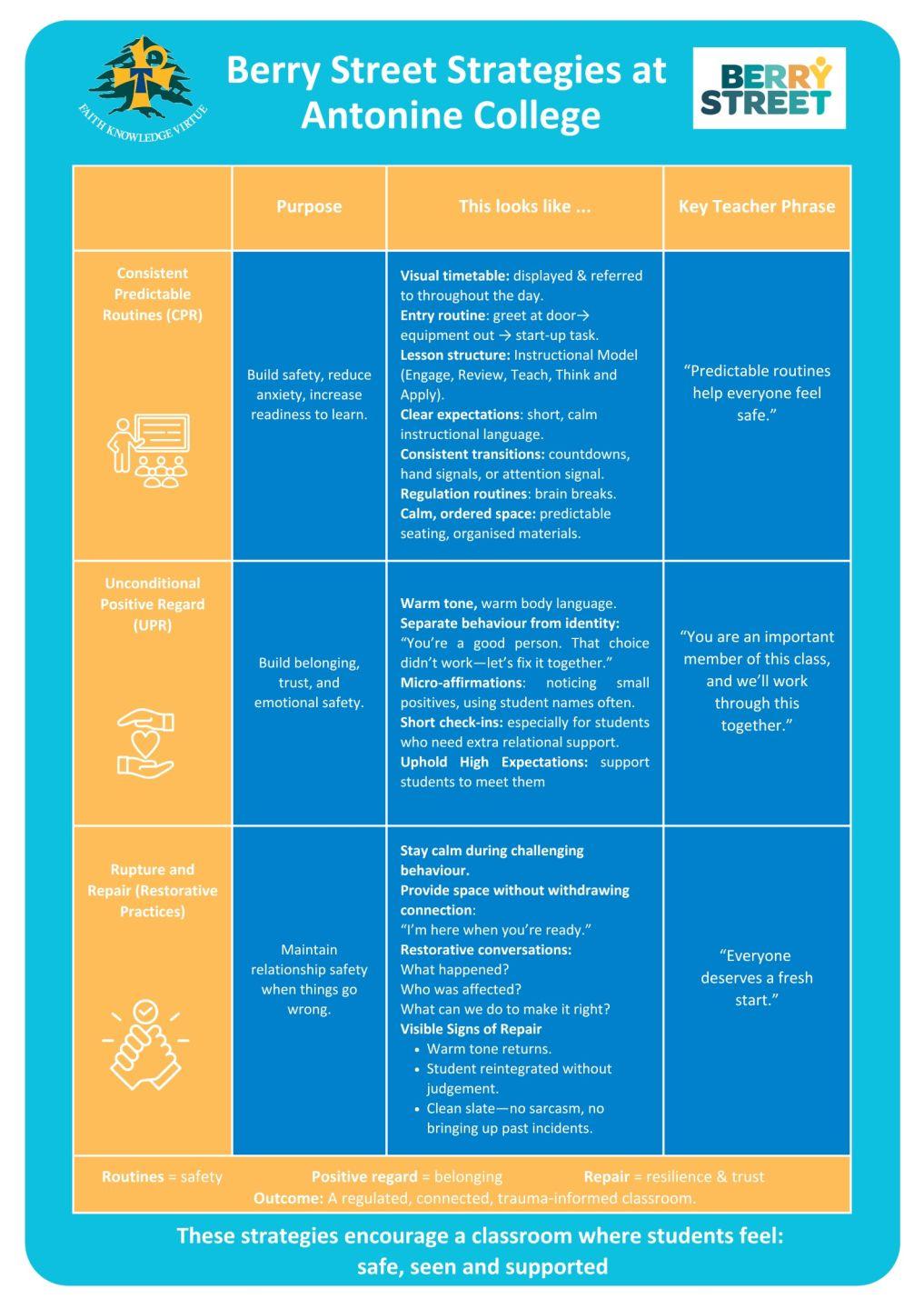
Over the past two years, staff at Antonine College have engaged in extensive professional learning in the Berry Street Education Model, a trauma‑informed approach to teaching and learning. In 2026, our campus is fully implementing a shared set of Berry Street strategies across 7-12 to ensure that every classroom is a safe, predictable and supportive learning environment for your child.
What is a trauma‑informed approach?
A trauma‑informed approach recognises that life experiences—such as stress, change, loss, or uncertainty—can impact a young person’s ability to focus, regulate emotions and engage in learning. Rather than asking “What’s wrong with this student?”, a trauma‑informed lens asks “What does this student need to succeed?”
At its heart, this approach supports students to feel:
Safe
Connected
Regulated
Ready to learn
When students experience these foundations, they are more able to engage positively in class, build relationships, and achieve their learning potential.
Our agreed Berry Street strategies
Our staff consistently apply three key Berry Street strategies:
1. Consistent, Predictable Routines
Students thrive when learning environments feel calm and predictable. Staff use clear routines and structures in every classroom, including:
Consistent lesson openings and closings
Visual schedules and clear expectations
Calm, instructional language and smooth transitions
Regular regulation breaks to help students reset and refocus
Why this matters: Predictable routines reduce anxiety and increase students’ readiness to learn, particularly for those who find change or uncertainty challenging.
2. Unconditional Positive Regard
Every student deserves to feel valued and respected; staff intentionally separate a student’s behaviour from who they are as a person by:
Maintaining warm, respectful interactions
Acknowledging effort and small successes
Using affirming language that reinforces belonging
Checking in with students who may need additional support
Why this matters: When students feel known, respected and cared for, they are more willing to take academic ownership, try harder (persist with challenging tasks), and engage positively with teachers and classmates.
3. Rupture and Repair (Restorative Practices)
Learning relationships don’t need to be perfect, but they do need repair when things go wrong. When challenges arise, staff remain calm and focus on restoring connection through:
Respectful conversations about what happened
Understanding who was affected
Supporting students to repair harm and move forward
Offering a genuine fresh start
Why this matters: Repairing relationships builds resilience, accountability and trust, skills students carry well beyond the classroom.
How this supports learning outcomes
Together, these strategies create classrooms where students feel safe, seen and supported. Research and practice consistently show that when students are regulated and connected, they are:
More engaged in learning
Better able to concentrate and persist
More confident to ask for help
More likely to experience academic success
Most importantly, these strategies allow teachers to spend more time on teaching and learning, and less time managing disruption.
Frequently Asked Questions
Does this mean there are no consequences for behaviour?
No. Clear boundaries and consequences remain an important part of our school expectations. A Berry Street approach does not remove consequences; instead, it ensures consequences are teaching‑focused, fair and restorative, helping students learn from mistakes and make better choices in the future.
Will learning standards be lowered?
No. In fact, these strategies support higher engagement and stronger learning outcomes. When students feel safe, connected and regulated, they are better able to concentrate, persist with challenging work and take responsibility for their learning.
Is this approach only for some students?
No. Berry Street strategies are used consistently across all classrooms and year levels. While some students benefit more visibly, these practices improve learning conditions for all students.
How does this help classrooms run calmly and effectively?
Consistent routines, clear expectations and strong relationships reduce disruption. This allows teachers to spend more time teaching, and students to spend more time learning, in calm and focused classrooms.
What happens if a student continues to struggle?
When challenges persist, staff provide additional support, work collaboratively with students and families, and use targeted interventions where needed. Our goal is always to support long‑term success, not short‑term compliance.
Working together
The Berry Street approach aligns strongly with our Catholic values of dignity, compassion and relationships with their faith and with others. By embedding these strategies consistently across our campus, we are building an environment where every student has the opportunity to flourish.
We thank parents and carers for your continued partnership as we support the wellbeing, growth and learning of every young person at Antonine College.
Year 10 Immunisations Monday 1 June 2026
Our students in Year 10 will have the opportunity to receieve the following immunisations by registered nurses
Meningococcal ACWY vaccine (MenQuadfi) offers protection from 4 strains of meningococcal disease (A,C,W & Y).
Optional: Meningococcal B optional vaccine for families who would like their child to have the first dose during this visit. This vaccine can be paid for in advance when families are providing consent for the Year 10 vaccine.
Attached is an information sheet about the immunisation program at Antonine College along with an informative PPT presentation.
Year 10 Parents please check your emails from the College with regards to providing consent in advance for these immunisations .
If you do not want your child to receive their immunisation at school, you will still need to let us know by selecting ‘NO CONSENT’ on via the link.
IMM Secondary School Immunisation Information 2026
- Ms Helen Diab